Starting a dairy business takes more than a good milk supply. You have to get the equipment that will match your budget, production needs and your customers. It may be confusing to decide between a small or large facility.
The optimal option for anyone who wants to invest in a Dairy plant in India will rely on the demand they can expect. Consider the amount of milk you are likely to have, local competition, and the growth rate of your sales. SM Engineering offers dairy processing equipment of various capacities to suit various business requirements so that customers can evaluate the capacity and product line before investing.
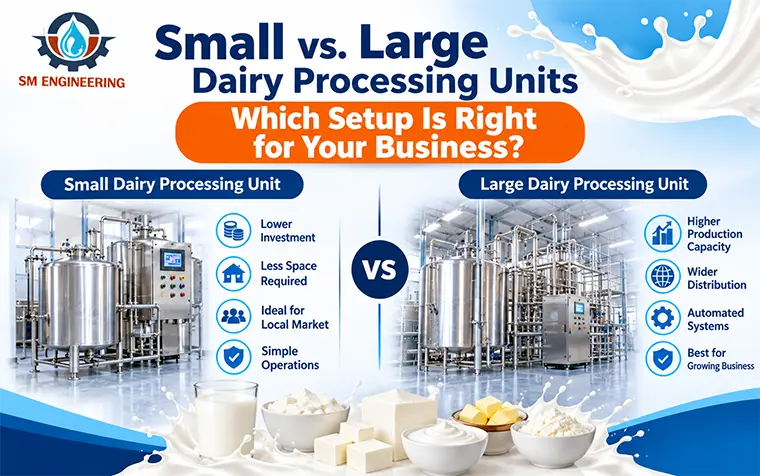
What is a Small Dairy Processing Unit?
A small unit is ideal for entrepreneurs, farmers, cooperatives, and businesses that cater to the local market. The products made depending on the equipment available could include curd, paneer, buttermilk, or ghee among others.
It has the biggest benefit of less investment and less setup. A business may need less space and manpower. However, when a business is overloaded with orders, it can be difficult for the business to keep up with it. Product safety and proper sanitation remain crucial.
What is a Large Dairy Processing Unit?
A large facility is meant for higher milk volumes and a wider distribution. Can consist of milk reception systems, bulk coolers, pasteuriser and homogeniser, storage tanks, packaging systems and automated controls.
Businesses can handle a bigger order and production schedule with increased capacity. However, large plants are more expensive, need more capital, space, utilities, trained personnel and maintenance. Idle capacity can be an issue for businesses.
Key Differences to Compare
- Start-up cost: Small units are normally cheaper to start. In large facilities more money will need to be spent on machinery, installation, buildings, and utilities.
- Production capacity: A small plant will have a local market, and a larger plant will have a larger order and distribution.
- Labour and automation: Smaller operations may use more labour. For larger facilities, several stages can be handled by an automatic system.
- Product range: A small unit can specialise in a limited number of products and then branch out from them at a later stage. If designed to do so, a larger plant might be able to run multiple lines.
- Operating cost: The overall operating cost may be lower in small facilities. For larger plants, the efficiency at scale can be achieved by regularly using the equipment.
How to Choose the Right Setup
Firstly, estimate your daily milk supply and a feasible quantity to sell. Have discussions with retail outlets, distributors, and customers to have an idea about the amount of production.
Create a budget for machinery, installation, utilities, labor, packing, cleaning, maintenance, and capital costs. The cost of purchase is just a portion of the overall cost.
Think about the products that you wish to manufacture. Production of pasteurized milk, curd, paneer, and flavored milk might involve different processing steps. Hygiene, temperature control, cleaning processes, and other safety concerns should also be considered in the plan.
Make plans for future expansions as well. Using modular machines and designing a flexible layout will help you increase production capacity without having to replace the whole system.
Choosing Reliable Equipment
A comparison with a Dairy plant in India should not just be based on the advertised capacity. Look at the quality of the material, how easily it can be cleaned, how it uses energy, the service support offered and whether it’s suitable for your product range. Discuss fitment, availability of installation and operator training.
We have a team of experts who can supply dairy processing machinery to suit various production needs. Provide the expected amount of milk, space, budget and products to match equipment.
Conclusion
Small and large dairy units fare well when they are able to respond to market demand. A smaller system may be needed for the new venture, while the larger system can be increased with an increase in sales.
Having chosen the Dairy plant in India, review the overall costs, production, and expansion. SM Engineering can give you information about what you need and what equipment types would be suitable for you.
Call to Action
Considering opening a dairy processing plant? Call SM Engineering to talk about your aims and appropriate machinery!