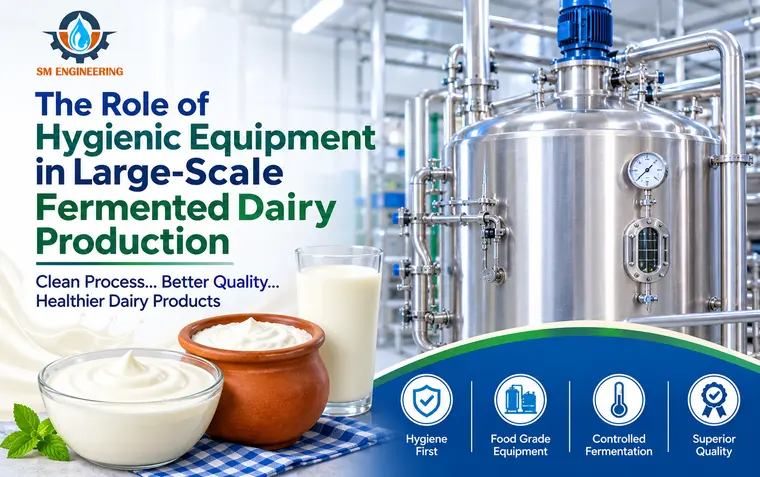
While curd and yogurt seem to be simple products, making them on a large scale is an art that requires great control over certain factors. The quality of milk used, cleanliness of machinery, temperature, and time of fermentation will all influence the end result. Minor mistake may influence the taste and the consistency of an entire batch.
For businesses planning a Fermentation tank for curd, hygiene should be a priority from the beginning. SM Engineering provides machinery for processing dairy products, which can be helpful when selecting appropriate equipment.
Why Hygiene Matters
Fermented milk products are dairy products that use selected microorganisms to ferment lactose in the milk to form lactic acid. The milk gets its taste and texture from the above process. As useful microorganisms play a role in the production process, then unwanted microorganisms have to be managed.
Residues found in tanks, pipelines, and valves may cause microbial contaminants. This will result in an odd taste and texture of foods.
Equipment That Supports Clean Production
- Milk storage tanks: Suitable storage of milk is necessary prior to processing. Food grade smooth surfaces and good connections of the tank are helpful in making the cleaning easy.
- Pasteurization equipment: Heat treatment is often required for the milk before addition of any starter culture. Properly operated machinery can help in reducing harmful microorganisms in the milk.
- Vessels for fermentation: Controlled conditions in which the curd or yoghurt forms is provided by such vessels.
- Piping and valves: The milk is transported using pipes and valves when it is processed. Hygienic equipment prevents the build up of the product in hard-to-reach areas.
- Cleaning systems: Clean-in-place systems pass the cleaning solution in equipment that can accommodate it. This process will still require proper chemicals, temperatures, contact time, and verification.
- Packaging equipment: Once the product has undergone fermentation and cooled, it should be packaged hygienically. Proper equipment for this process will preserve the product’s integrity.
How Hygienic Design Improves Consistency
Customers expect each batch to have a familiar taste and texture. Effective cleaning and controlled production will help minimize any undesired variations between batches. Temperature regulation is very important as the fermentation process may be slow or fast depending on how the temperature is controlled.
The tools that are used should be non-porous, have good drainage, have inspectable components, and also cleanable connections. Regular maintenance matters too. Worn seals, damaged surfaces, or leaking valves can create places where residues collect. Scheduled checks help staff find problems before production is affected.
Choosing the Right Tank
While selecting a Fermentation Tank for the curd, take into account batch volume, daily volume of milk, temperature for fermentation, need for stirring, cleaning procedure, and texture. It is recommended to select the tank that best fits your process rather than the tank with highest capacity.
Material is another aspect. The surface which will come into contact with food must be appropriate for dairy processing, should have the capability to resist corrosion under expected conditions and should withstand the proposed method of cleaning.
Cost-effective purchasing is also essential. A cheap price initially may become more expensive due to difficulty in cleaning and frequent maintenance.
Planning a Reliable Dairy Line
SM Engineering provides dairy processing machinery and plant solutions for different production requirements. The suppliers should be consulted before the purchase of the equipment on the tank sizes, processing steps, hygiene requirements, and cleaning requirements.
The efficiency of the equipment will improve when there are proper cleaning procedures and well-trained individuals managing the equipment. The cleaning and maintenance process must be recorded for future reference in cases where there are any quality issues.
Hygienic equipment is a very important part of ensuring safety and reliability during the manufacture of fermented dairy products. Tanks, pipes, sanitation, and fermentation are some of the means by which manufacturers are able to control their quality as they grow in their manufacturing.
Before making a decision to buy the Fermentation tank for curd, it is very important for you to take into account your product needs, capacity, cleaning process, and considerations for the future. We will help you select your equipment through SM Engineering.
Conclusion
Hygienic equipment is a very important part of ensuring safety and reliability during the manufacture of fermented dairy products. Tanks, pipes, sanitation, and fermentation are some of the means by which manufacturers are able to control their quality as they grow in their manufacturing.
Before making a decision to buy the Fermentation tank for curd, it is very important for you to take into account your product needs, capacity, cleaning process, and considerations for the future. We will help you select your equipment through SM Engineering.
Contact SM Engineering to discuss your curd or yoghurt production requirements and explore suitable dairy processing equipment for your facility.