Setting up a dairy processing plant requires consideration of how you will handle, process, store and sanitise your milk and milk products as part of your business. You will need to ensure your equipment and layout is set up to comply with any food safety requirements.
The FSSAI (Food Safety and Standards Authority of India) lays down licensing requirements, hygiene and food safety requirements for all food businesses. Selecting FSSAI standard dairy plant manufacturers can help you plan your machinery to accommodate these needs.
SM Engineering supply dairy processing machinery and offer turnkey dairy plant solutions. We understand the importance of using hygienic equipment, suitable materials and layout to help you plan your processing.
What does FSSAI mean?
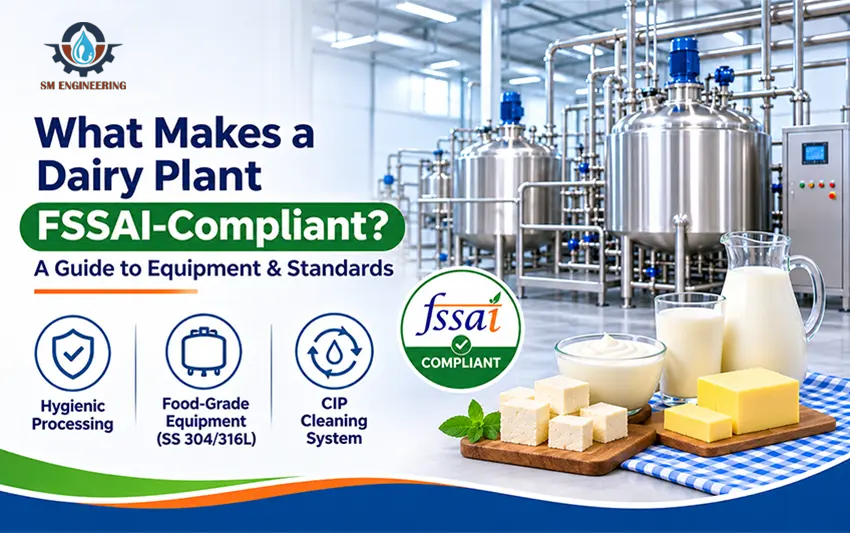
The dairy food business will be FSSAI compliant if:
- Food Business Operators have the correct licence/registration as per Food Safety and Standards (Licensing and Registration of Food Businesses) Regulations 2011.
- They follow the correct requirements including Good Manufacturing Practice (GMP), Good Hygiene Practice (GHP) requirements (schedule 4). Milk and Milk Products are included (Part III).
The following should be considered when planning the dairy plant to ensure that FSSAI requirements are met:
- Raw milk and products are handled in a hygienic way.
- Appropriate layout of the premises and processing area.
- Equipment and surfaces are easily cleanable.
- Correct temperature controls.
- Cross contamination is avoided.
- Correct cleaning, sanitation and pest control.
- Staff trained in food handling and food safety procedures are in place.
- Correct product, packaging and labelling standards.
The plant owner/food business operator will be responsible for ensuring they have the correct licence. Equipment manufacturers will ensure the machinery is designed for the correct food processing.
Key FSSAI Hygiene Requirements
A dairy processing facility should be planned to minimise the risk of contamination. Below are some key points to consider.
1. Hygienic Handling of Raw Milk- Raw milk should be handled and stored correctly. The dairy plant should have the correct facilities in place for receiving, transferring, chilling and storing milk.
Milk should be received in an area which minimises the risk of contamination. Milk storage and transfer pipework should be suitable for dairy applications.
2. Food Contact Equipment- Equipment which comes into contact with milk/dairy products should be made from materials which don’t corrode and are easily cleaned and disinfected. Common materials used for food grade dairy equipment are stainless steels (SS 304/SS 316L). The correct grade will depend on the product, cleaning chemicals and conditions of the plant.
Equipment should also be designed to help with hygiene.
3. Cleaning and Disinfecting- Equipment should be regularly cleaned to remove any milk build up. FSSAI set out the requirements for good cleaning and disinfecting in dairy plants. This includes having the correct cleaning in place (CIP) systems.
There should be a written cleaning schedule to show what equipment will be cleaned, when it’ll be cleaned, how it’ll be cleaned and verified.
4. Avoiding Cross Contamination- Raw milk, processed milk and dairy products should be handled to avoid cross contamination.
The plant should be laid out to ensure there is appropriate segregation of raw materials, heating, processing, packaging and storage.
5. Drainage- Floors in processing areas should be durable and waterproof. Having suitable drainage can help reduce water build up.
Wastewater should be planned to meet the correct local and environmental requirements.
6. Pest Control & Chemical Storage- There should be appropriate pest control in place. Cleaning chemicals, detergents and disinfectant should be safely stored in designated areas away from the ingredients and finished product.
Essential Equipment
Depending on the dairy products you want to produce and the scale of your business, there are a number of pieces of equipment commonly used. These include:
- Milk Receiving Tanks- These are used to receive and store raw milk. They should be designed to help with handling in a hygienic manner and temperature control. They should also be easy to clean.
- Bulk Milk Coolers- These help lower the temperature of raw milk after collection. It should be chilled to the correct temperature to help slow down the growth of microorganisms.
- Milk Pasteuriser- This equipment heats the milk at the correct time and temperature. It should be designed to allow accurate control of the process.
- Homogeniser- This reduces the size of fat globules in the milk. It should be used if needed for the product formulation.
- Processing Tanks- These are used for mixing, heating, fermenting and preparing your product. They should be designed to help with hygienic contact with the product, cleaning and safe processing.
- Cream Separator- This separates the milk into cream and skimmed milk using centrifugal force. They’ll be used in a dairy plant producing cream, butter, ghee and other dairy products.
- Cleaning In Place (CIP) - This system helps clean compatible tanks, pipework and equipment with cleaning solution. It should be designed according to the equipment in your plant and your cleaning schedule.
- Packaging Equipment- This equipment will fill your dairy product into the correct containers/pouches. The filling area should be designed to help with hygienic handling.
Choosing the Correct Equipment
When looking at FSSAI standard dairy plant manufacturers, you should consider more than just the capacity and cost of the equipment. Things to consider include:
- Material- Ask what stainless steel grades are used in the product contact areas. Ensure it’s suitable for your dairy product, cleaning chemicals and conditions.
- Hygiene Design- Ensure product contact areas can be easily cleaned. The design should help reduce build-up of milk. Pipework, welding, joints, valves etc. should be suitable for hygienic processing.
- Cleaning- Ask if the equipment can be manually cleaned or has a CIP system. It should be easy to clean depending on your processing schedule.
- Capacity- Ensure the capacity of your tanks, pasteuriser, coolers and packaging equipment are all matched. If they are not matched it could cause delays and issues with temperature.
- Temperature & Control- Milk processing will involve processes that need to be carried out at the correct temperature. Ensure there are suitable measuring tools and controls.
- Layout- Ensure the equipment can help with a logical flow of milk and dairy products. Segregation and transfer should help reduce the risk of cross contamination.
- Technical Information- Ask for any relevant technical information relating to the equipment. This could include specification, material information, operation instructions, cleaning instructions and testing documents.
How SM Engineering Can Help
SM Engineering manufacture dairy processing equipment and offer turnkey solutions for dairy businesses. We are based in Ahmedabad, Gujarat and work with customers who want to set up milk processing facilities and produce products such as paneer, curd, butter, ghee and buttermilk.
We understand that hygienic processing will depend on choosing the correct equipment, materials, cleaning and layout.
We can help with:
- Food grade stainless steel – We use SS 304 and SS 316L on our liquid contact areas.
- Dairy Processing Equipment – We offer a range of equipment including milk pasteurisers, bulk milk coolers, milk storage tanks, homogenisers, cream separators and dairy product processing.
- CIP – We can offer CIP cleaning.
- Planning – We’ll consider your capacity, product range, space and automation to help with equipment layout.
- Turnkey – We can offer a range of services to help with your project including layout planning, installation, commissioning and training.
- Technical Support – We can help advise on how to operate, clean and maintain the equipment.
Our aim is to help you with hygienic processing. We would advise you to review the correct FSSAI requirements for your business activity and product range.
Conclusion
An FSSAI compliant dairy plant should be planned to ensure correct equipment, premises, processing, cleaning, storage and food safety. Food contact equipment should be suitable for dairy products, easy to clean and designed to help with hygienic processing.
When choosing FSSAI standard dairy plant manufacturers ensure they understand dairy processing, what materials they offer, what equipment they offer, how they can help with cleaning and what support they can offer with your project. Whilst having machinery can support you with compliance, the dairy business will need to put the correct food safety procedures in place and have the correct licence/registration from FSSAI.
SM Engineering offers dairy processing equipment and turnkey solutions. So get in touch with us and let us know what products you want to produce, how much capacity and what your plant requirements are.