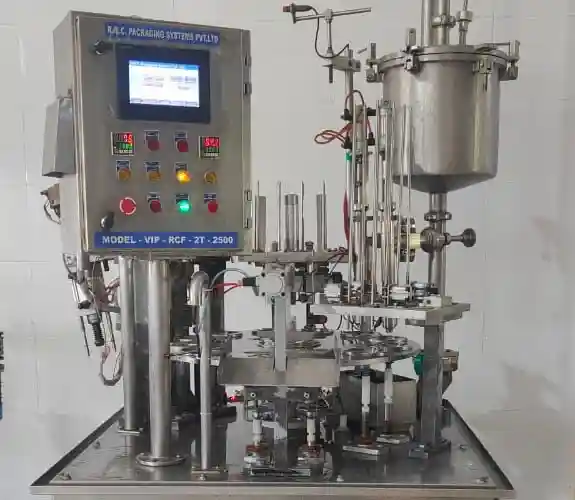
This type of machine usually operates on a Rotary Table or a single-track, step-by-step process.1
The specifications below are typical for a standard commercial semi-automatic unit:
| Specification | Typical Value Range | Key Notes |
|---|---|---|
| Production Capacity | 500 to 1,000 Cups per Hour (CPH) | Highly dependent on operator speed and cup volume. Not suitable for large-scale continuous lines. |
| Filling Range (Volume) | 50 ml to 500 ml | Most machines handle wide ranges; requires change parts (rings/nozzles) for different cup diameters. |
| Dosing System | Volumetric Piston Filler or Timed Pump | Piston fillers offer high accuracy (±1% to 2%) and are excellent for viscous products like yogurt. |
| Machine Type | Rotary Table or Single-Head Linear | Rotary type is common, where the operator manually indexes (turns) the table. |
| Material of Construction | SS 304 or SS 316 (Product contact parts) | Ensures hygiene and resistance to acidic dairy products and cleaning chemicals. |
| Power Consumption | 0.5 kW to 1.5 kW | Low power demand; often runs on single-phase supply (220V/50Hz). |
| Air Pressure Requirement | 6 to 8 Bar | Required for pneumatic cylinders used in sealing and sometimes filling operations. |
The key defining feature is the blend of manual and automated tasks:
| Step | Operation Mode | Description |
|---|---|---|
| 1. Cup Feeding | Manual (Operator) | The operator places empty, pre-formed plastic cups (e.g., PP, PS) into the machine's mold/pocket. |
| 2. Filling | Automatic | The rotary table is indexed (manually or by foot switch) to the filling station. The machine accurately dispenses the pre-set volume of yogurt. |
| 3. Foil Placement | Manual (Operator) | The operator takes a pre-cut foil/lidding film and places it onto the filled cup. |
| 4. Sealing | Automatic | The machine indexes to the sealing station. The sealing head applies heat and pressure for a precise time to fuse the foil to the cup rim. |
| 5. Ejection/Discharge | Manual or Semi-Automatic | The operator removes the finished, sealed cup, or the machine uses a pneumatic pusher to discharge it onto a small table. |
| Feature Category | Feature / Attachment | Importance |
|---|---|---|
| Hygienic Control | SS Product Hopper (with jacket/agitator) | Stores the yogurt before filling; agitation prevents separation. Jacketing allows chilling to maintain product temperature. |
| Quality Control | 'No Cup - No Fill' Sensor | Basic safety mechanism; prevents yogurt from spilling if a cup is missing in the pocket. |
| Temperature Control | Digital Temperature Controller | Controls the heat applied to the sealing head, ensuring a secure and consistent seal without melting the cup. |
| Product Customization | Dual Head / Two-Stage Filling (Optional) | Allows filling fruit preparation first, followed by plain yogurt, ideal for fruit-on-the-bottom style yogurt. |
| Traceability | Date/Batch Coding (Optional) | A manual or automatic stamp (often hot-foil) applied during or after the sealing process. |
| Portability | Caster Wheels | Common feature for small units, allowing easy movement for cleaning and re-positioning. |
This machine type is ideal for:

Would you like to know more about the changeover process for different cup sizes, or perhaps the typical utility installation requirements (like the air compressor needed)?