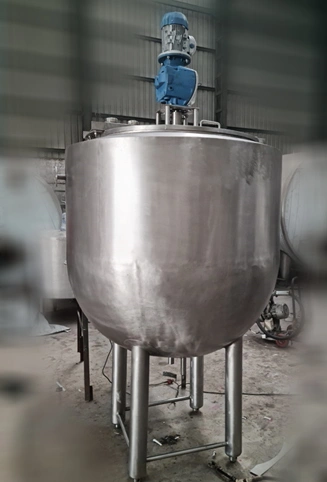
As a leading manufacturer of dairy processing equipment, SM Engineering provides state-of-the-art Ghee Making Plants designed for optimal efficiency and superior product quality. Our turnkey solutions empower dairy industries to produce high-purity, traditional ghee with an extended shelf life, while maintaining the highest standards of hygiene and consistency.

Ghee Making Process The process typically involves the thermal clarification of butter or cream to remove moisture and non-fat milk solids.
Butter/Cream is transferred into a jacketed vessel (Ghee Boiler) and gently heated until it completely melts into liquid fat and water/solids.
The liquid is slowly heated (boiled) to a specific temperature (around 105°C to 115°C). This evaporates the moisture and separates the curd residue (milk solids).
Heating continues until the milk solids turn a light golden brown, and the resultant liquid fat is clear and golden. This clear liquid is ghee.
The hot, clarified ghee is pumped through a filter press or centrifuge to completely remove the brown milk solids (ghee residue)
The filtered ghee is quickly cooled to the desired crystallization temperature and then transferred to the Ghee Filling Machine for packaging.
The core equipment is designed to handle the high-temperature heating and separation phases:
The central piece of equipment, a jacketed vessel (usually steam or electrically heated) used for the melting, heating, and clarification (boiling) steps. It is equipped with an agitator and temperature controls.
A tank used for the initial slow melting of the raw material (butter or cream).
Used to rapidly and effectively separate the clarified liquid ghee from the solid residue (ghee residue/curd).
Insulated tanks used for holding the ghee post-filtration, allowing it to settle before cooling, or for final storage.
Equipment that accurately fills the liquid or semi-solid ghee into final consumer packs (jars, tins, pouches).
Stainless steel product transfer pumps and a Clean-in-Place (CIP) system for sanitation.